
August 11, 2026
Adam Riches: The Critics’ Way – 15:10 at Underbelly Cowgate, Cow Café
A character show on the subject of comedy reviewing is a fun meta-concept that didn’t have quite enough in it to stretch over an hour, so luckily, Adam Riches didn’t try to do that. He capped it at a little over 45 minutes, and none of it felt like padding.
This show did occasionally suffer from a common problem in character comedy, in which for the audience, spending 45 minutes with a skewering parody of an obnoxious horrible guy is still spending 45 minutes with an obnoxious horrible guy. This was a bigger issue at the beginning of the show, but lessened significantly as it went along, and Riches jumped quickly from one routine to another, giving us just enough time to laugh at how annoying it is, but not long enough to get actually annoyed. A few little character-breaking moments helped with that as well.
The show says some interesting things about a topic that is very “inside baseball” – the ethics of comedy critique – but an Edinburgh Fringe crowd is exactly its target audience, people who want this niche material. Its points are entertainingly expressed, and while I left thinking it would be ironically funny to give a bad review to this show about the harm done by bad reviews, I enjoyed it too much for that. Funny character, solid show.
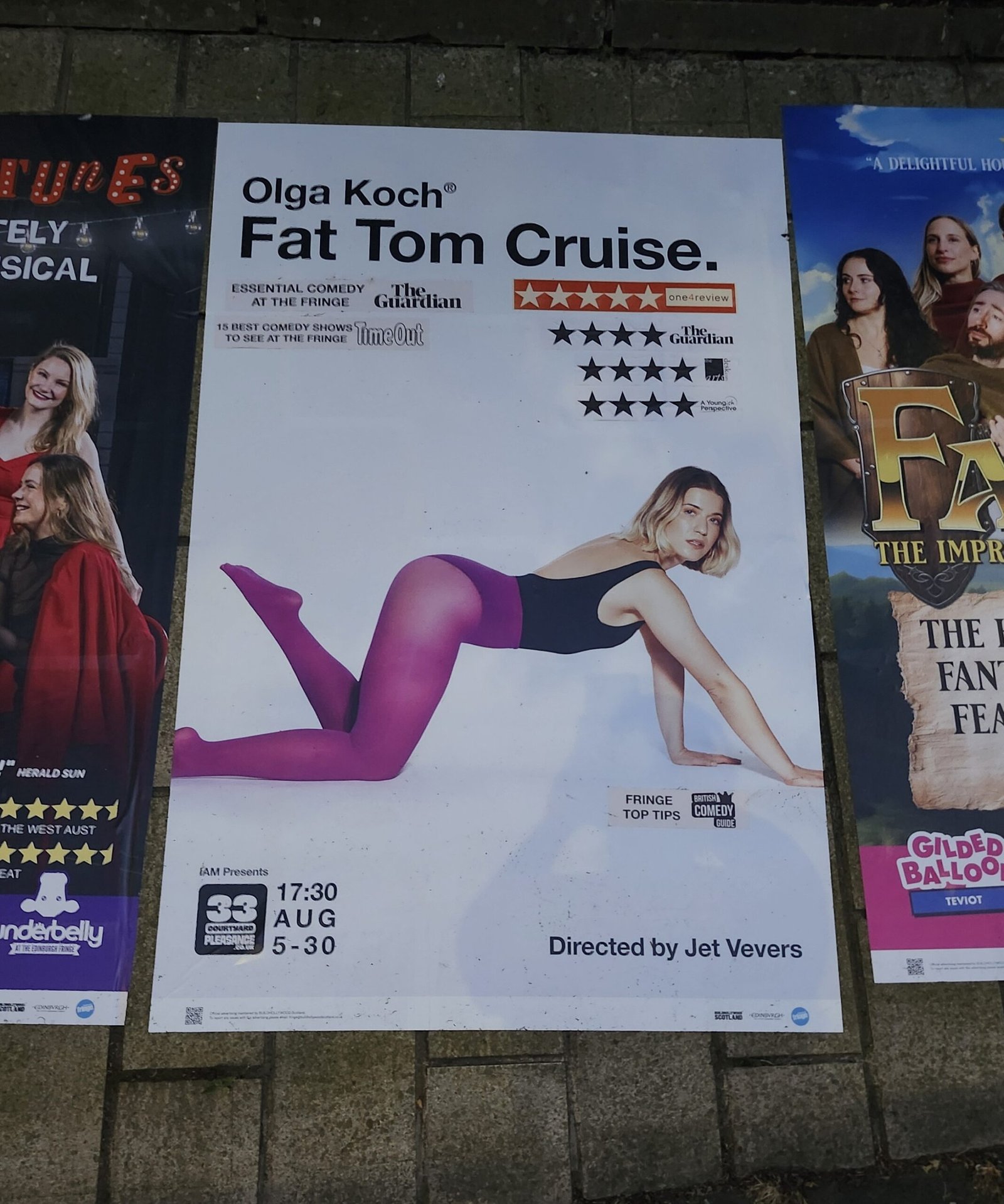
Olga Koch: Fat Tom Cruise – 17:30 at Pleasance Courtyard, Fourth
This is far more theatrical than Olga Koch’s (strong) back catalogue of stand-up, and she takes to the theatrics so well that it makes me wonder why she’s not used them before. There’s background music to a lot of the hour. There are so many sound effects and lighting cues and Koch repeatedly references how hard the tech employee has to work. There are three separate screens that display words to underline her points, sometimes further words flash all over the stage. And there are quite a few sudden dance breaks.
All of these elements tie into her central message, though it takes the full hour to reveal the extent of their relevance. Fat Tom Cruise had a long WIP period, and it shows in the finished product – Koch had most of the material written by a year ago, and has taken extreme care in working out how to present it.
This is important, as the show tackles a complex subject, tries to say something trickily nuanced about it, and runs the risk of being misinterpreted in a number of unfortunate ways if she doesn’t express herself exactly right (Koch seems to have an affinity for that sort of thing, as this sentence could also be said about her previous show, Comes From Money). I think she pulls this off successfully yet again; a few recently-added lines crucially clarify her position, and that demonstrates the extent of her attention to detail.
It’s also very funny – the jokes are constant, especially in the most difficult parts of the material, and Koch’s infectiously positive stage presence gives the audience permission to laugh even at some very dark stuff (though always – or almost always – delivered with a smile and a flourish). This comedy is smart and insightful about the human condition, but if you’re not in the mood to engage with all that, you could also go to this show just to enjoy how much it’ll make you laugh.
Kemah Bob: Love Child – 18:50 at Pleasance Courtyard, Upstairs
This is a classic autobiographical hour, with stories of Bob’s parents and grandparents and childhood wrapped around a throughline about one particular night out. It was a fun thing to see right after Olga Koch’s show, as it made for two hours in a row of (queer female) young Millennial comedians who trade on glamour that could almost distract an audience from how much real talent goes into what they write. They also both had stories about cocaine, and references to Mortal Kombat.
Bob doesn’t have any props, but her sparkly costume tells as much of a story as some comedians’ entire stage worth of set dressing. She jumps around, kicks her feet, waves her arms, breaks into dance, lets you know that she is putting on a show. She also slowly lets the air out of this as she reveals more and more of her story, and plays with what it means in context. I always like a show where the style underlines the content, and this is certainly one in that category.
This show got a lot of well-earned laughs from the extremely engaged audience, Bob’s intense stage presence taking over the relatively small room. It covers some dark topics, such as childhood trauma, family instability, poverty, and mental health issues. Bob skips over these with joy and determination to find jokes in all of them; it’s a wonderfully fun hour.
Spencer Jones: Dogs – 20:15 at Pleasance Dome, Queen Dome
Spencer Jones has quite a lot of props. He also has a synthesizer. Her has an electronic keyboard, he has some masks, and he has a remote-controlled dog. He has some cups and some puppets. He presses a lot of buttons, sings some songs, and the energy he generates from this courses through the audience like a fire. Every laugh begets more of them, as the audience enjoys both the joke, and the daftness of how this sort of thing can be funny. It’s a celebration of childishness – a loose theme that comes back a few times across the hour, and gets hammered in a bit at the end, but is worn lightly. Mostly, this is a show about nothing more than how funny it is to see paper mache move around to synthesized beats at an arts festival, and that’s a beautiful thing.
Jordan Brookes: The Part of You That’s Always Screaming – 21:45 at Pleasance Dome, Queen Dome
Jordan Brookes has done it again, and I can think of few ways to give a show higher praise than that, that the record-holder for the longest run with the Edinburgh Best Show Award (on a pandemic-related technicality) has lived up to his own high standards. This show is a bit stripped down compared to some of his previous stuff – no props, no background, no headphones, no elaborate musical. But with just his words, his tone, his nightmare-ish facial expressions, and his perfectly formed gangly movements, he can still make the audience feel like we’re watching anything but “straight stand-up”.
There is one sequence in which the show gets theatrical in Brookes’ more usual style, with lighting changes and music accompanying a round of physical comedy that is both incredibly funny and genuinely scary at the exact same time, to a truly impressive degree. I won’t spoil further details, but I will say: if you’re watching this show and thinking it’s a shame there’s not more physical stuff in it, don’t worry, he’ll get there. Those five minutes pack far more of a metaphorical punch than most comedians can do in an hour.
In the past, Jordan Brookes has tackled some big-picture subjects, but in this show, he drives down hard and relentlessly into an incredibly specific aspect of the human experience (or at least, some humans’ experience – the experience of Jordan Brookes, and of the type of audience members who go to see Jordan Brookes): an inner monologue that creates an imaginary audience and constantly performs for it. There aren’t many aspects of everyday life left that comedians haven’t run into the ground in observational comedy, but Brookes has found some, here. He’s found something so small and so omnipresent that we’re almost never consciously aware of its existence, but as this show painted a picture of it, a room full of audience members gasped in recognition.
This hour had multiple sections in which the vast majority of the audience, including me, could not breathe from laughter for minutes or more at a time. The kind of absolute, helpless belly laughs that set a new standard for what comedy can be. It turns out that Brookes is just as relentlessly funny without props or backing singers as he is with them.
 Dave Baillie