
When it comes to world-building Jane Schoenbrun’s Teenage Sex and Death at Camp Miasma deserves some kind of an award for covering the most ground in the shortest time period. Over the credits we’re introduced to the Camp Miasma series of horror films in a number of amusing ways, from old vhs videos to press releases and cuttings, plus a cute selection of tacky merchandise, and there are lots of knowing nods to anyone who has ever sat through a similar series ala Friday The 13th or A Nightmare on Elm Street.
Now decades on from the last film, director Kris Williams (Hannah Einbinder) has been tasked with rebooting the property, and she’s been specifically chosen as the original film was transphobic and someone’s needed to address this. Kris is fully aware of why she’s been given the job, but also wants to create something which has genuine value, and that involves persuading the original movie’s final girl Billy Presley (Gillian Anderson) to come out of retirement for the first time in decades. And so Kris heads out to the middle of nowhere on a freezing cold snowy day to attend a meeting, only to find that Presley now lives in the location the first Camp Miasma movie was filmed in.
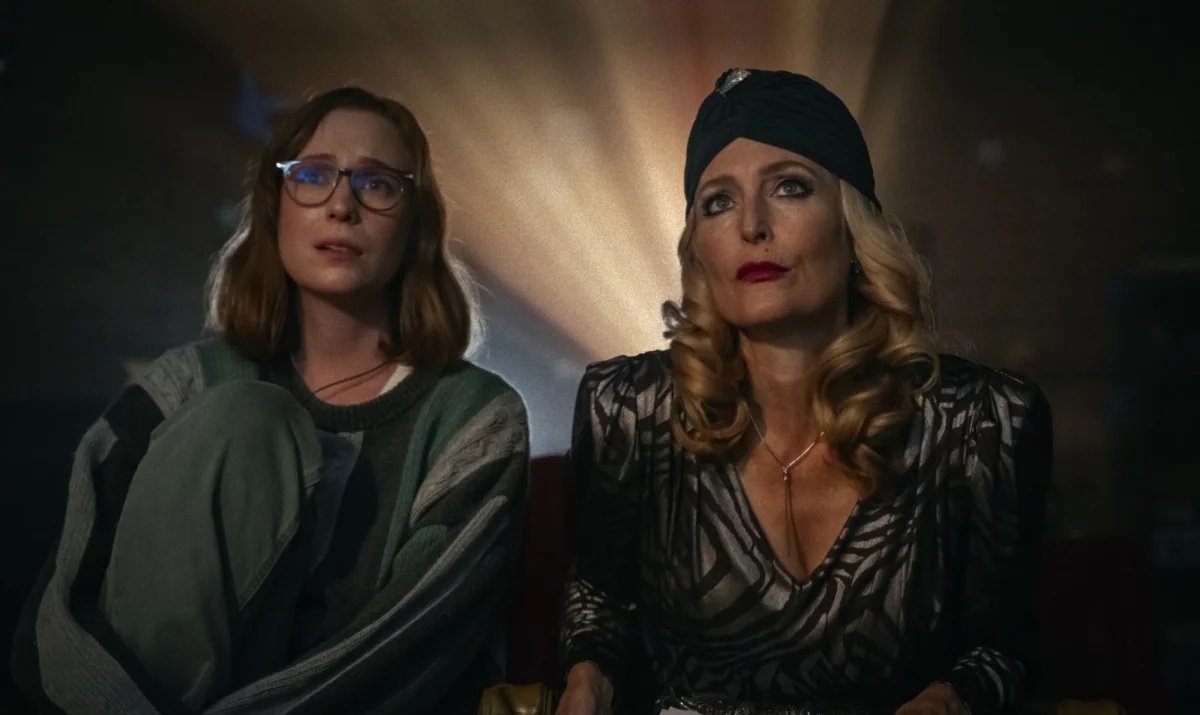
At this point the film becomes much more playful, and unusual, as we’re shown long sections of Kris and Billy watching the first Camp Miasma movie, along with occasional commentary on the things that shouldn’t have been acceptable back when it was supposedly made. The centre piece is a five minute gory slaughter set to music, but the entire section beautifully satirises horror movie tropes, though we’re not in Scream territory here, this is a far smarter, far stranger film which has a lot of other ideas that it throws in to the mix.
The lines between reality and fiction become increasingly blurred, with some parts clearly filmed in front of a matte backdrop, while seasonal changes burst across the screen towards the end. There’s also a visually unique exploration of sexuality in an oddly upbeat and positive manner, and the film becomes funnier as it goes on, containing a surprising number of laugh out loud moments. Both leads are sublime throughout, with Anderson clearly enjoying the chance to ham it up and then some in certain scenes, while at the perfect moment making her character painfully human. Einbinder matches her performance as she explores her relationship with horror, with how such films exploited their casts, but also how they were responsible for introducing a certain audience to sex, and that despite being dark and bloody affairs that might not always be problematic.
Schoenbrun’s direction is frisky and mischevious, and while horror devotees will undoubtedly get the most out of this, this weirdly endearing slice of insanity will delight anyone who enjoys unconventional cinema which explores unusual topics. It’s a visual pleasure, sprints off in peculiar directions in ways I never tired of, and has the most satisfying ending of the year, and as long as you don’t mind your leads being covered in buckets of blood this is essential viewing.
 Dave Baillie
 Sarah Stringer