
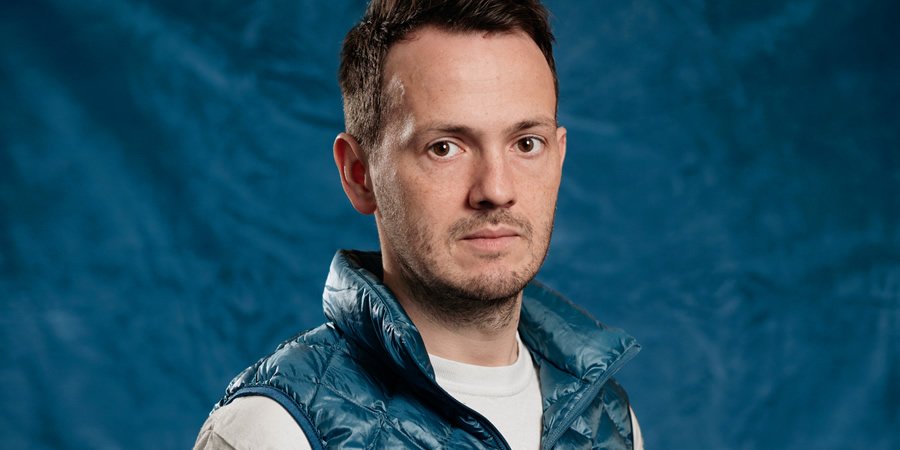
Stuart Laws is all over the comedy industry: he does his own stand-up, he hosts collaborative shows like Pub Games and Michael Caine parodies with other comedians, and he directs and produces stand-up. He runs the media company Turtle Canyon, which has created many of the high-profile UK stand-up specials from the past fifteen years.
In 2026, Laws has been busy: in addition to his behind-the-scenes work on other comedians’ shows, he’s just released a new special with his own latest material. Earlier this year, he sold out The Pleasance Theatre with the final performance of his popular “Stuart Laws as Michael Caine Saying Never For an Hour” show, which featured a large cast of other comedians and a cameo from Mr. Blobby. He then began a new show that featured his Michael Caine character, and a new collaborative show involving a flying simulator.
On October 8, 2026, I sat down with Stuart Laws in the bar attached to the Young Vic. Freshly back from a series of gigs in the US, we had a conversation about his work in comedy, on his own shows, and behind-the-scenes with other people.
This interview has been lightly edited for clarity.
Stringer: You’ve been to the United States and back frequently in the last few years. When you’re performing there, what do you do differently from when you’re here?
Laws: I speak slower. Partly because a big part of comedy, obviously, is the audience has to instinctively understand what’s happening. With my accent, and the way I speak – in the UK, I speak fast, the words slur together a little bit. In America, they’re already thinking, ‘Oh, that word’s pronounced slightly differently.’ In the same way that when you hear an American speaking, you think, ‘Oh, they’re saying Tuesday differently.’ Your brain is slightly focused on other things. So I slow down a little bit, just so they’re not missing things.
I’m sure as time goes on, I’ll be able to speed back up and get into better rhythms, or I’ll learn how to pronounce their words in a way that’s better. It’s a very tiny thing, it just gives them a chance to understand. And you have to change some words, some of the words are different.
I have a joke about a cinema, but they say ‘movie theatre’. So I have to change, because if you say ‘cinema’, in their mind, they’re thinking, art house. And I mean just a general, going out to movies. It’s little tweaks like that. But largely, it’s so similar. As long as the reference points are not the Chuckle Brothers – you know, as long as you’ve got the right reference points, or it’s just generic, everyday sort of stuff, they are head and shoulders above British audiences.
Stringer: How so?
Laws: How they respond, laughing. Their openness to hearing what the comedian has to say. New York is definitely tighter, because it’s a very comedy-savvy town, it’s seen everything, and it’s seen every variant of every thing. In the same way London is, but maybe even more so in New York.
But out on the road, I would say in the UK, you have 30 seconds to prove yourself, and in America you have 5 minutes to prove yourself. And as a British person I’ve got even more time to prove myself, because they’re like, ‘This is fun. We already like that this guy’s a bit different. I hope he talks about being British.’ Some of the most fun gigs I’ve ever had have been over there, because the on-ramp to the gig is so much gentler. You can play around, and they’re like, ‘Oh cool, this guy is different, he’s a bit odd, he’s got some funny jokes, this is going to be a really good, fun time.’ Whereas the UK can sometimes be like, ‘Right, okay. This guy better be funny.’
Stringer: You’ve done a lot of shows about puffins. Do you try to be more mainstream in the US, in case audiences who don’t know you might give the puffin-type stuff less of a chance?
Laws: I definitely – especially in New York – have been actively working out what the most mainstream of my material is. I get to pick from seven hours of jokes, and go, ‘What’s the twenty minutes that is representative of me, and is hard punchlines, whilst also being a little bit different?’
In Nashville recently, I was doing an eight-minute set, and I would say I did sixteen minutes of material in eight minutes. Because I just told the jokes, I didn’t do the extras – there might be a tag on the end of one, or there might be a bit of scene building at the start of another. But I was like, ‘Nope, I’ll just do the jokes.’ If I can talk to someone and do something funny with the audience, that’ll be fun. But otherwise, strip it back to: joke, joke, joke, joke, joke, thank you, that’s my time, have a good night.
Stringer: Going back to your 2016 hour, So Preoccupied with Whether Or Not He Could, and then to your 2025 one, Stuart Laws Is Stuck, is there a significance to you repeatedly writing about puffins? Or are they just a funny animal?
Laws: The first one came about from one of my first-ever routines that I could never get to work. It was that I had a job painting the beaks on puffins, to physically paint the actual puffin’s beak.
That would have been 2010 or 2009. It was me being like, ‘Oh, I’m a wacky comedian.’ And I liked puffins, but I also had found out that their beaks fall off, the colourful bit disappears. So I thought it would be funny if someone’s job were to top up the paint on them. But I could never make it work.
I then did three hours at the Edinburgh Fringe – 2013, 14, 15 – and was trying desperately to work out what the next one would be. And I did a show where I brought that back up, that my job was to work at a puffin sanctuary. I thought that could be a framing device for a show. I did the show, it went pretty well. Some mixed reviews, some good reviews, some good audiences.
Some radio people saw it, and wanted to develop it into a radio show. And it never got made, but we spent a long time trying to work out what it is. And what we worked out eventually did become the play in 2025. So over the years of trying to write this radio sitcom, it went from being a four-episode thing on Radio 4, to a ten-episode thing with the option for a second series on Audible. It changed to beavers at one point. It changed from being on an island to the Scottish Highlands where the beavers are being repopulated.
It was evolving and evolving until eventually I was like, ‘It’s not happening. I can’t go through another producer, and another submission process. There’s definitely something still in it, and I think, if I repurpose it now, change what it’s all about, it will be something more interesting, and I can just do that. And then maybe that, weirdly, will then lead back to doing a radio show or something. Doing it in this format might get it in front of other producers, and it might revitalize the old idea again.’
Stringer: So it must have changed a lot, because the original show was before you were diagnosed with autism [and the 2025 puffin-based show has a metaphor about autism].
Laws: Yes, it wasn’t about being autistic. Or it probably subliminally was, but it was about loneliness, and mental health stuff, and trying to find external reasons for what’s going on with yourself.
Stringer: How did the specific metaphor in [the 2025 puffin-based show] Stuart Laws Is Stuck come about?
Laws: It started there. I knew I needed a framing device. When I first performed it in October 2024, it was a 35-page script, and I did it in the Bill Murray, to 20 or 25 people, with Heidi Regan, and the end I said, ‘Right, there’s no ending to that. What questions do you have?’ And even then, I don’t think it had autism thematic elements to it.
It was a murder mystery, and I knew I wanted to have some sort of Christopher Nolan-y twist. But I hadn’t figured it out. And part of doing it on stage was me being like, ‘Let’s just figure out what this is. Whether there are any legs to it. Whether the jokes land, whether the concept lands.’
It didn’t take shape properly until early 2025. Kate Hammer coming on board really helped solidify and streamline it. When I was auditioning people, I was hoping she would audition. And I was hoping she would be good at the audition. Because I was like, ‘On paper, you’re the person I want to work with.’
Stringer: So you auditioned a bunch of people, but you wanted to hire her?
Laws: I was really hoping she would not be bad. So when she was good I said, ‘Great, there’s no debate here.’ Everyone else who auditioned did great versions of it; I just knew that Kate had the acting and the comedy side of it, but she’s a director as well. She’s neurodivergent, and I knew she would latch onto it and understand it, and help make it better.
Stringer: Are you planning to perform the Is Stuck show any more?
Laws: We did a short run of it at the Free Association Theatre in May, to find out if there’s still something in this. I always thought there was. I think we did it three times, and we made it better. Basically, it’s just too far down the agenda at the moment. I spoke to the Shedinburgh team about maybe doing a one-off at the Fringe, and it didn’t quite fit in with the schedule because I already had one show blocked in.
But to talk to them and say, ‘I have this show, and I have a good tape of it, and I want to find a theatre producer, and I want to lean into the theatre side, not the stand-up side. I don’t want to direct it myself, I want to have someone come in.’ We dial up the murder mystery element, we make that plot more solid. That means that when the thematic and subtextual stuff comes through, it could potentially land harder, because you get carried away by the murder mystery element. Whereas at the moment, it’s mainly a monologue with funny interstitial scenes, but I don’t think anyone is wondering, ‘Who actually did it?’ People aren’t enjoying it for the ‘whodunnit’, they’re enjoying it for the ‘why done it’.
Alasdair Beckett-King came to see it – he’s a very good comedian – he said, ‘I can’t wait to come along and see if I can work out whodunnit.’ And I had to keep quiet, because I couldn’t say, ‘You’re not going to – that’s not really it.’ But that is what I want it to be in the future: 75 minutes, and there’s a genuine question of whether it was this person, that puffin, or whatever. And have it feel like a legit Mousetrap-style murder mystery. Not fully that, obviously, but an Agatha Christie-ish, or Sherlock, or something in that regard. Something an audience can go watch purely for that, and then have the rug pull at the end be even more surprising because of it.
Because it sold really well, I was delighted about how it did, I’m pretty sure the majority of the audiences seeing it were there because they knew a little bit of my work. And therefore the expectation, I would assume, is there’s something else going on. Whereas if I can make something that’s sold purely as a murder mystery with puffins, and then there’s that rug pull, I think that might be more powerful.
Stringer: You have to do the Daniel Kitson thing, and put it in the theatre section.
Laws: Yeah, yeah. He came and saw it in Edinburgh, and was very nice about it. Maybe I should have a chat with him, and ask, ‘What’s the plan?’
Monkey Barrel were very nice, in that I said, ‘This is what I want to do.’ And they said, ‘We’ve never done anything like that, but we would love to give it a go.’ I wanted it to work in a room that was not a theatre room, because I wanted to see what was possible. To see that it holds up as a show, then the next stage would be pure theatre.
I think it might be a bit tougher to explore stuff, because we were changing it every day, and if it’s pure theatre, we have to lock it in, to hit the cues. Beth was the tech, she came down and did the London tech as well. She was very good at improvising in certain moments, and that’s my ethos, in trying to work out how a show comes together.
Stringer: Are there any plans to film it?
Laws: I do have a good taping of it, but that’s mainly just for archive, or to be able to send to a producer. I would love to do a two- or three-week run of it off West End, and then explore what is happening with it. Because there are various plans, but I need to speak with producers and agents about what the next stage is.
Stringer: In your collaborative shows like pub games, or the Michael Caine shows, or even the Flying to Gibraltar shows, how do you decide who to bring in on that?
Laws: Obviously I love Kate, and her being involved in anything. We have very similar senses of humour, we get on very well. We both have the same instincts, but in different ways. She’s a much bigger performer than me, but I think that contrasts really nicely.
Nish [Kumar] doing Christopher Nolan for the first time was literally me texting Nish: ‘I want to do a live version of this tweet. You’d be Christopher Nolan, I’d be Michael Caine, what do you reckon?’ He was like, ‘Yeah, love it.’ In that case I just asked who would be the best Christopher Nolan that I know, and Nish knows so much about Nolan. It’s silly and dumb and playful, so he’s the ideal choice. In the shows that I did of this in Edinburgh, having Nish do it was so perfect.
There were times when I could just sit down and be like, ‘Cool, they’ve got it. Whatever’s happening there is funny enough so Michael Caine doesn’t need to be involved.’ And that’s a fun thing, to be able to take a backseat for a bit, because the setup that I’ve created has allowed everyone to be really funny. Also, Phil [Wang], and Lorna [Rose Treen], and Zachary [Ruane], and Kemah [Bob] are all incredibly funny by themselves, as well.
I like working with people, I like finding the right collaborations. I think I am very good at listening, and ‘yes and’-ing. I don’t do improv, but I think I am good at improv, and I like the ethos of improv. I just am not a massive improv fan. When it’s good, it’s incredible. But what I am doing is often improv.
In March, we did a Michael Caine Saying Never For an Hour show, at The Pleasance, and that was a cast of 15 or 20 people. I wrote an intro joke or bit for each person, and then said – you come in at 30 minutes, you come in at 9 minutes. I just briefed every person. But aside from all that, if something comes to them, they just do it. So I like creating situations where it is improv, but it’s slightly more structured. Each person knows they get to enter with a joke or a bit, there’s a comfort to that. So they get to be funny, then stay on stage and build on anything else that’s happening. It’s 10% scripted, 90% improv. That 10% gives everyone the comfort to say, ‘I know my character, and I’ve gotten a laugh, and I can do this now.’
The same thing with the flying show – it will expand and have more people. I’m doing one in December that will have a bigger cast, with the same ethos. In the Never show, nobody really knew each other’s storylines, because that’s what it would be like on a movie set. That meant they could all interact with each other in a way that changes for every show.
Stringer: In the original Never shows, Nish Kumar and Jordan Brookes have both played Christopher Nolan, and did very different things. What were the common instructions that you gave them?
Laws: Very little with Nish. We met with me, Nish, and Amy Gledhill, who played Christian Bale, and we just chatted. We said there were some bits where he could say, ‘No that’s crazy’, or ‘Dial it down’, or ‘You’re doing weird neck stuff now’.
The joke is, I guess, that Michael Caine is dumb, and can’t take direction, and has gotten stuck on this word. So, mentally, where is Michael at? He’s so desperate to get out of this situation he’s got in, he latches onto anything that is said to him. Because he’s like, ‘Maybe that’s my way out.’ And with Phil Wang as Liam Neeson, I said, ‘Pick up on any tiny detail you can, and get it wrong. Fixate on the wrong bit of information, and then overcorrect the other way, and Nish will get increasingly frustrated.’
For the original one, we came up with a few bits. I briefed them on, ‘This is what worked, this is what didn’t work, this is stuff that is worth exploring. And we’re going to have these three extra cast members come in and do things. You won’t know what they are, but you respond to them. You’re getting more and more frustrated.’ It’s about giving enough information so the person feels able to do what they want, but also staying within the boundaries of – you don’t want anyone breaking the show, being so blunt and straightforward that the heightened reality is broken.
Obviously I’m working with incredible comedians who get what the point of it all is. And then sometimes you work with someone like Mark Silcox, who’s so funny, you just have to cue him for specific things. And then anything else that happens with it, you just let it happen.
Stringer: For several years you did a show as Michael Caine trying to say “Never” on the Batman Begins tapings, and now are doing a new one as the same Micahel Caine character, but now he’s running an acting class in 2026. How did the evolution from Michael Caine Never shows to Michael Caine 2.0 come about?
Laws: Shedinburgh, who run the venue, got in touch to say, ‘We would love you to do it.’ John Britton, who’s a theatre director and dramaturge, he had seen the Never show and loved it. He said, ‘This should be on at Shedinburgh, this is the sort of thing we want to be doing at Shedinburgh. In amongst all the incredible theatre and the monologues and the workshops and things like that, we want something very dumb, very silly.’
I was very grateful, but I basically, by that point, had already put it to bed in my head. I was like, ‘I’ve already done the last Never show.’ I didn’t want it to get stale, to have diminishing returns. So I said, ‘I would like to do it, but I would like it to be something different from the Never show, with the same ethos. Can we just sign it up as Stuart Laws as Michael Caine Does Something For an Hour, and I’ll work it out?’
And in the last Never show in London, I had incorporated a bit of Michael Caine’s acting masterclass – that’s a famous thing that Michael Caine did, he had an acting masterclass. He taught people how to do eye contact with the camera, and which way you should be looking, which way you shouldn’t be looking. It’s very funny, but it’s also very good. It was filmed in the 80s, or the late 70s. And I was like, ‘That’s what it’s got to be. How does Nish get involved again?’ Because Nish was up for doing it.
I was like, ‘Okay, that’s what it is. It’s Michael Caine welcoming on his friends from TV and film.’ The audience are the students, which is what happens in his acting masterclass. They’re learning from him, they’re asking questions. I was like, ‘That will be the structure for it. But it’s in an alternative world where Michael Caine lives on campus in a film school somewhere, and every Friday night, he comes down, he does An Audience with Michael Caine, and he has a couple of guests on, and he teaches you how to do acting, the director teaching you how to do directing.’ That, to me, is a concept that can run and run.
A chat show is good, but a chat show is the soft way into doing the act-outs. Because what I think people love about the Never show is a director getting frustrated, watching the repetition, seeing what people get stuck on, what Michael Caine gets stuck on. Also, Benjamin Alborough has a brilliant show, which is a chat show, the Terry Wogan chat show, which I’ve been on. And he’s been in the Never show. So I thought the world doesn’t need another chat show, but what I haven’t seen is a full acting masterclass.
I thought, that’s the way to do it. But you just test out ideas, you see what works. We keep the chat element pretty vague, pretty chill. I really tried to do it as purely non-joke questions, as genuine questions, to allow the character to answer in character. It’s not about finding punchlines in those early bits, it’s just about easing the audience in, and being like, ‘This is Liam Neeson, and we all like that this is Liam Neeson.’
Stringer: The final Never show was advertised as the final Never show. Did you do that because you planned to turn it into something else?
Laws: The film junket second half was me testing if there’s something in this. I thought that maybe it could be a good comedy show, to extend the life of Michael Caine. But it had not been fully planned. I knew that we had a long slot and I knew we were filming it, and I knew we had an incredible cast, so I was like, ‘Let’s just get everyone out there, the big hitters, and just see what plays out.’
And Jasmine, who was the film journalist who did that, she was an actual film journalist, who was so shocked to get the offer, and loved it, and had a nice time. She was so good, because I wanted it to be an actual film journalist, who’s treating it like it’s 100% real, no matter what happens, no matter that Blobby’s there.
Stringer: When you’re performing your own live show, mainly stand-up but any of the other stuff too, is there anything that you do differently because of your perspective as both a producer and director? Because you can have an eye on what would work when editing the film later, or on what you would advise someone to do as a director?
Laws: I always say to people I’m working with, ‘You’ve got to break the show at some point. You’ve got to change it, you’ve got to put the ending at the beginning, you’ve got to do stuff like that. Occasionally you’re going to die on your ass, but that will teach you about the show. If you do jokes out of order, then suddenly you aren’t in the comfort zone of thinking, “that joke comes after that joke, which means I get to do a little callback to that joke, and it gets an extra laugh.” Suddenly, each joke is living and dying by itself, but then you might find new links. It’s all about keeping it fresh enough in your head that you’re learning stuff about the show.’
I think instinctively now, I have so many things in my head, where I understand how to be on stage, how to maximize my movement on stage, because of seeing things as a director. I’m like, ‘Oh, on screen that would look like this.’ I’m not processing that at the time, but – there’s a clip that I went viral for where I got booed for not having kids, and I asked them to explain themselves, and then I did a response, and it went viral as a crowd work thing. I’m very proud of how I responded to that, it was fast. There was a stool there, and so I went and sat on the stool, to basically say, ‘I’m listening to you, please feel free.’ And almost to say to the audience, ‘We’re in a different phase now, we’re gong to be listening to this person.’ And also in my head, framing-wise, or watching it, it’s more interesting that I’m now on a stool. Then, the point when I got off the stool became significant. And, sure, it probably would have done good numbers if I didn’t sit on the stool. But there was something about the formality of getting booed, not slamming them immediately, taking a seat to listen to what they’ve got to say. I even stopped the audience from booing her at one point.
There are all these little things that are partly from doing comedy for years and years, but partly from having watched so much comedy on screen, that I’ll instinctively build it more filmically. And there are loads of times when I’ll get that wrong. I tried to include in my special, bits where I was doing stuff with the cameras, or messing around in ways that I knew would look visually more interesting on camera.
Certain things translate well to screen, certain things translate well to live. Long, long, long, long pauses work really well in a live room because there’s the danger, but on screen, it’s a chance for the audience to look at their phones. So you ask, ‘What can I do that’s interesting with a pause?’ Rather than just letting it all play out. So, it’s all those little things. Sometimes it’s pre-planned, and sometimes it’s an accident that you try to make the best of in the moment. And sometimes it’s like, you are improvising your body position and what you’re doing, because you’re in the flow, and you’re present, and you’re responding to what’s happening in the room.
Stringer: On a comedy special, what’s the difference between a director and a producer?
Laws: Essentially, the producer is the one organizing it all. Booking in the operators, booking in the kit, liaising with the venue. It’s basically doing more of the admin jobs. They’re in charge of the money, and saying, ‘Well we can’t do that, but how about this?’
The director is the one that’s saying, ‘Here’s the vision.’ Chatting with the act, working on what the show is about. Saying, ‘I would like to have this many cameras in these positions on these lenses.’ That’s through their director of photography as well. And then the producer says, ‘Well, you can have six of those cameras, but you can’t have all of them if you also want to have this. What’s the workaround?’
Oftentimes, because I’ve done directing so much, when I’m producing, I will be chatting with whoever directs, and I know what it’s like to be in in their shoes. So I can say, ‘We can’t do that, but having seen the person before, I know they perform over here, in this way. Maybe we could do this.’ And then the director will say, ‘Oh yeah, that’s a good idea,’ or, ‘No, I definitely need that, so let’s work out another way of making it work.’
Also, the job as a producer, sometimes, is to not overstep creatively. It’s just to put out fires without anyone knowing there was a fire. The main job on anything like that is always making sure the comedian can be the best comedian they can be.
With directing, I’ve often been in the green room with them after the show, chatting about it, prepping for the next one. Sometimes I know that their partner’s up there with them, so I think, ‘They don’t need me up there right now. They need to just chill out, have a nice time.’ You have to gauge – ‘I’m actually not that good friends with that one, so I will try to be as helpful or as unhelpful as they need.’ Some people just want reassurance, some people want to be told, ‘You did this bit wrong, fix it.’
Stringer: It’s a coach.
Laws: Yeah, yeah, really. There is a difference between a show director and a special director, and sometimes they cross over. I directed Kate Hammer’s show at the Fringe this year, which wasn’t filmed, but I was like, ‘Right. I want more material on this. The opening five minutes is not quite right. I need you to address this, this, and this. We need to get that out of the way. The structure’s okay, but at the moment we’re getting a bit lost in the middle.’ That’s not necessarily what I said to Kate, but all of those sorts of things can come up.
Sometimes it’s, ‘Your performances need to be worked on. We need to work on eye contact.’ Some people are very funny when they’re big, but if you have an hour of someone being big, it can be distracting. So I tell them, ‘Let’s find the rhythms where, when you’re performing big, it’s a surprise, and it’s funny, rather than wearing us out.’
Then, for directing a special, it’s saying, ‘Right, what’s the show about? I’ve watched you perform, you perform like this. I feel like the cameras should be moving like this, I think we should have one here because that would represent this. I think we should have this sort of lighting setup, maybe.’ Then you go to your heads of department, if you’ve got the budget, and say, ‘We want it to feel natural and organic and old-fashioned. We’re going to get retro lenses, we’re going to do this.’
Ed Gamble’s special is coming out soon, and he was like, ‘I would love it to just look crisp, sharp, pristine.’ And I was like, ‘Great. We want the lighting to not have shadows, we want it to be bam, clean.’ You work those things out with the comedian.
I went and watched Sindhu Vee’s show, and I said, ‘I have some suggestions for structure and stuff like that, but you don’t have to take them. If you want, I’ll just focus on the picture.’ And she said, ‘No, let’s talk about it.’ So we worked together on making the tour show a special.
Sometimes a routine that works really well in the room is not actually right for the special. Because a special can be whatever you want it to be, whereas a tour show has to be a certain length of time, and has to work all around the country in different venues and different places. You say, ‘That routine was only ever there because people found it very funny, but it wasn’t really linked to the show. So let’s tighten that in, focus it.’
Stringer: Something like the beach footage in the Li Jin Hao special – where did that come from?
Laws: That was Jin; he was like, ‘I want to do something like this with it.’ We talked about being in a forest, and we talked about a few different things. He sent over a PDF of the visual styles he likes. Not all comedians do that, some do. I said, ‘Great, we’re going to film it at the Bill Murray. We’re going to film it unlike a normal special – we’re going to just put three cameras at the back of the room, each one at a different zoom length, one wide, one mid, one close, all from about the same area. And then we’re going to light it not with the venue lighting, we’re going to light it with our own lights, so it’s more filmically lit. And we’re going to tell the audience that that’s what we’re doing’. Knowing that the show is, A) really good, but B) dreamlike. And it has a different energy.
I said to him, ‘I want to match cut you on the beach with you in the room. So I want it to match up, so you start each of the chapters on the beach, the nightmares. And then we transition back to the room, and it’s obviously not an identical cut, but it’s the same framing. So it feels planned, and it feels whole, and it feels deliberate.’ That’s another very important thing, that audience feel choices were made. Even if they don’t like the comedy, they can’t deny that it was planned, and it’s thought out.
Stringer: Something like when you cut to the audience, or when you cut from a close shot to farther – would that be decided by the director, or just the film editor?
Laws: Again, it’s person to person, act to act. I have a very good editor. Al [Clayton], who I run Turtle Canyon with, really is one of the best comedy editors. He’ll take anything and he’ll find the rhythms.We have some acts who want to sit there and go through every cut. Sometimes, they just give general broad feedback, and they say, ‘It feels a bit too pacey at this bit.’ Or, ‘Could it be on the close at this bit, because I say this thing, and I like it to be on the close?’ So you work with them a bit on that. And sometimes, it’s literally me with the editor going through it ourselves, and saying, ‘Shift it there slightly, tweak it.’
Stringer: Did you do that because you’re a director who’s also involved with the company that does the editing? Or would any director do that?
Laws: Sometimes they do, but oftentimes they’ll just get a link, they’ll watch it and provide notes. The director will provide: ‘Here are the key shots, here’s the pacing rhythm of how regularly I want edits to happen.’
Chloe Radcliffe’s special’s out soon, and I directed that, but I said to the operators, ‘We have three states. We have normal Chloe; we have cinematic Chloe, when she’s telling a story that is more deliberate and slower paced; and then we have frantic, chaos Chloe. When we’re in cinematic mode, if you’re operating and she moved quickly out of shot, don’t jerk to go after her. Let her go out of shot, and then catch her up again, in a smooth move. But if we’re in frantic, you’re jerking to get her. We’re basically, as camera operators, replicating the energy she’s giving out.’
Then it applies the same to the edit, where we want long, long shots without edits for the cinematic moments – when she’s that deliberate, you don’t need to be cutting away. And sometimes within that, the focus might not be quite right, or the framing might not be quite right.
So really, I think, as an audience, you go, ‘Well this is live, and it’s happening, and it’s real.’ Rather than a film, in which everything has been meticulously planned. And I think, as an audience, you want to have an element of, ‘This is real, and it’s happening, and there’s a danger element to it.’ And it’ll be appropriate in different shows – some shows need to be slick slick slick. Sindhu is so controlled. But in some shows you want to have the element of – ‘Whoa, we didn’t know what was happening there.’ And if you include that in the edit, it heightens the sense of danger.
Stringer: Thank you so much for your time.
Stuart Laws will be performing his new show, Stuart Laws Flies the Audience To…, at The Pleasance Theatre on December 8, 2026. Keep up with Turtle Canyon’s upcoming releases on their Youtube channel.