
I’ve made a list of twenty feminism-containing stand-up specials that I love. I’ll be re-watching them, and writing short reviews of them, in alphabetical order. I’ve done this as an antidote to some of the difficult news this week – part 1 of the list, and a further explanation of what it is, can be found here.
Here is part 2, shows 6-10:
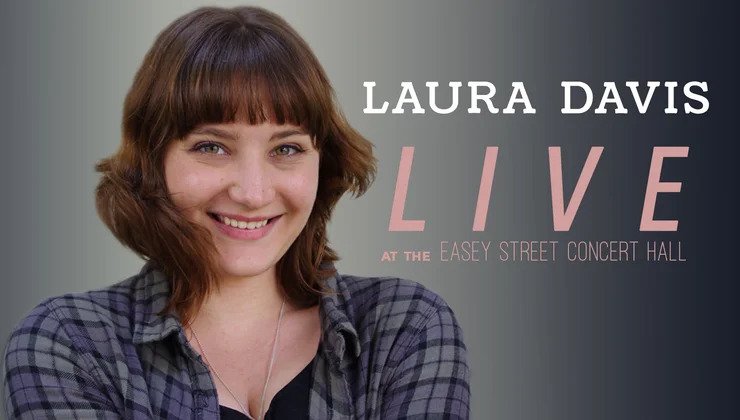
Laura Davis: Live at the Easy Street Concert Hall (2016)
Laura Davis has been reckoning with existential questions on stage for over ten years now, and it’s interesting to go back to 2016 and see how the reckoning’s evolved. In this show, the big questions and the small questions blend together so tightly that the audience can hardly see the seams. Davis jumps from maple syrup bottles to splitting the atom to the evolving feminist sensibilities of rapists to the smallest essential components of all matter to how women live alongside their statistically greatest predator to misogynistic religious sexual education.
Live at the Easy Street Concert Hall is a bit less dense than some of Davis’ more recent hours, but it covers similarly vast ground, and gives a similar sense of trying to reach beyond itself, to grasp something bigger. Davis hits on day-to-day concerns that face women who want to be safe and respected, and they draw extended connections from those to the general difficulty of existence.
Here’s a line I often find myself saying, after I explain the subject matter of a Laura Davis show: I swear, it’s funnier than that description makes it sound. And it really is. Davis doesn’t shy away from the darker parts, and a lot of the humour comes from the absurdity of how normalized stuff is. They find contrasts between big things and small things, big things that we treat as small and small things that we treat as big. Those contrasts are very funny.
There are some brilliant routines in this show, two of the best being about different types of scary and horrible misogyny, and taking it to ridiculous logical conclusions. It’s a fantastic introduction to Laura Davis for anyone not already familiar with their work, and interesting foundational context for anyone who knows them only by their more recent stuff. And, as I’ve learned today, it makes a good rewatch for anyone who’s seen this one before.
It’s nice that alphabetical order brought this show up right after the Laura Davis one, because Laura Davis and Alice Fraser make me feel a similar sense of awe at the scale of their ambition, the complexity in their masterpieces (they are also the two comedians who make it hardest for me to avoid the cliché of being a reviewer who compares all good comedy to Daniel Kitson).
Alice Fraser is also the second comedian in this collection was a lawyer before she quit that job for comedy. You can see traces of this all over the precision in her structure and word choices, the way she covers every argument from every angle, constantly going back over her own points to explain “Of course you could also argue this other thing, but that would mean…”
Ethos is Fraser’s first show after the (excellent) trilogy that explored her family history. Ethos discusses her family a bit, but it breaks new ground by spending more time on abstract subjects. Its essential theme is the power of language, the fickle and context-dependent nature of language, the misinterpretation and tangling up of language. This topic doesn’t stay academic – she relates it to major political conflicts, the meaning of love, casual misogyny, her relationship to her own Judaism, and how to respond to racism.
It’s a tricky line to walk, and Fraser found a great way to keep in humour even when wandering into the weeds of analysis: she set up the show as a double act with a robot. This adds a whole second layer that offers opportunities for jokes when the subject matter seems to offer none, with the robot chiming in from a different perspective. It also gives Fraser a chance to disagree with herself on stage, while keeping things somewhat organized. And of course, she ties the robot deeply into the show’s central themes.
Sarah Keyworth: Dark Horse (2021)
This special is a 2021 recording of Dark Horse, the show that got Sarah Keyworth nominated for the Best Newcomer Award at the Edinburgh Fringe Festival in 2018. A debut hour performed with the confidence the comedian has gained by a few years later, it’s interesting to see how things have changed. For example, there’s a routine about how they don’t understand the meaning of letters in the queer acronym past L, G, B, and T; and Keyworth acknowledges that this joke doesn’t work the same way as it did in 2018, as they’ve now come out as non-binary.
This show is largely about gender, and even if Keyworth’s labels and identity have changed since it was written, the underlying experiences are still in play. It’s about the expectations Keyworth felt at various life stages: as a tomboy child, then an adolescent girl who struggled with not fitting into femininity, then a university student who tried to appear straight and feminine, then finally an adult butch lesbian who felt comfortable being themself.
It’s standard for a debut hour to be autobiographical, as a way to introduce the audience to who this comedian is. However, Dark Horse moves beyond describing Keyworth’s own life; they discus their own relationship with femininity, but also other people’s. Their university friends, their mother, their goddaughter – all these people respond to misogynistic stereotypes differently, and Keyworth’s stories lend value to everyone’s experiences.
Dark Horse has themes of mutual understanding, of seeing the way the same oppressive constraints can affect different people in different ways. There are funny anecdotes that will be relatable to anyone who’s tried to move through the world as a gender non-conforming person who’s viewed as a woman, and these are balanced well with any more serious ruminations.
This is a recording of Josie Long’s stand-up hour that she wrote in 2019. In July 2020, she was meant to be touring it in theatres, but because those were all closed for some reason that no one can remember now, she filmed a special performance in her backyard, to an audience of her then-partner (one of those cis men who makes good and feminist comedy, they do exist) and a few of her neighbours.
Long states early on that this show is about childbirth and climate change, which is both accurate and much too small to capture its scope. It’s a show about childbirth, and climate change, and resistance, and resilience, and courage in the face of fear, and tenderness in the face of pain, and vertigo in the face of the future, and anti-capitalism, and the primal nature of parental love, and the beacon of hope that is the ever-present concept of moving to Scotland.
By 2020, Josie Long had been talking on stage about wanting to move to Scotland for nearly ten years. Tender includes some more material about this, and it’s her last full stand-up hour before she actually did it. Because dreams do come true, and that is why we can keep having children even through an apocalypse. What does that have to do with moving to Scotland? I’m not quite sure, but Josie Long sure makes it sound like this makes sense; she has a knack for making it easy to believe in anything.
Josie Long also has a knack for doing very hopeful shows about very dark topics, and Tender feels like the pinnacle of that. She scrapes through the darkness, finds every tiny bit of happiness within it, and holds out her hands to excitedly share it with the audience.
Tender is funny, and it’s thoughtful. There are ingrained structural pieces and well-honed ideas that can be easy to miss in her seemingly haphazard enthusiasm, but it comes together beautifully.
The second show on this list that won the Edinburgh Comedy Award (under a different name than the award had when Bridget Christie won it), and you can see why, as it feels like a career-establishing show. Horndog did define a new era of Matafeo’s career; she was already a TV star and an award-winning stand-up in New Zealand, but this was her first big success in the UK, launching her toward greater heights.
It’s a show about love and passion, and the awkward, painful ways we deal with feelings within ourselves that are too big to rationally understand. Matafeo puts together several types of passion in this show – her teenage crushes, her adult romantic relationships, teenage girls’ obsession with boy bands. All types of passion that she describes as embarrassing and overwhelming and best hidden away, but Horndog brings them out into the open to relate to other people.
A lot of the show goes into her past; some of it almost a period piece about capturing the specific cultural vibe of being a teenage girl in 2005. 2005, when “girl power” was in magazines but female sexuality was a mystery to be explored. Boybands and Neopets and internet message boards and collages of celebrity crushes.
Horndog is meticulously well presented – there are screens on stage that illustrate the story, there are sound effects and musical cues, the costume is relevant, and of course there’s a big finale worthy of any Edinburgh Fringe Award-winning show.
 Alex Finch