
It’s been a big week for news in the comedy world. A week of rare victories for some victims, which have drawn out important conversations about the many other victims who haven’t got justice (yet), and who else might still be being protected at their expense. I am glad these conversations are happening, and I am very glad some justice was done.
However, this means reading the news and related discussions this week has been emotionally tough, as it requires so much time spent thinking about predatory men. As an antidote to that, I have gathered twenty of my favourite stand-up specials that contain feminism. I will be rewatching them and posting some short reviews, in four parts.
I say these specials “contain feminism”, because it feels reductive to call them “feminist stand-up specials”. These shows contain multitudes, and feminism is one of many elements. And arguably, a foundation that underpins many elements.
This is also not a list of The 20 Best Feminist Stand-Up Specials, because that would suggest that all other feminist shows are worse than these ones, which is untrue and counterproductive. There are far more than twenty great feminist stand-up shows out there: shows made by people of various classes, races, sexual orientations, genders (even some by cis men, though none of those will feature here, as part of my Campaign to Not Talk About Cis Men For a Bit), ages, neurotypes, abilities, nationalities, and styles of comedy. I’ve picked out just a few of them, and I’ll write about them in alphabetical order, to avoid ranking them in any other way. Because feminists don’t pit feminists against each other.
Having said that, here is part 1 of my list, the first five shows:
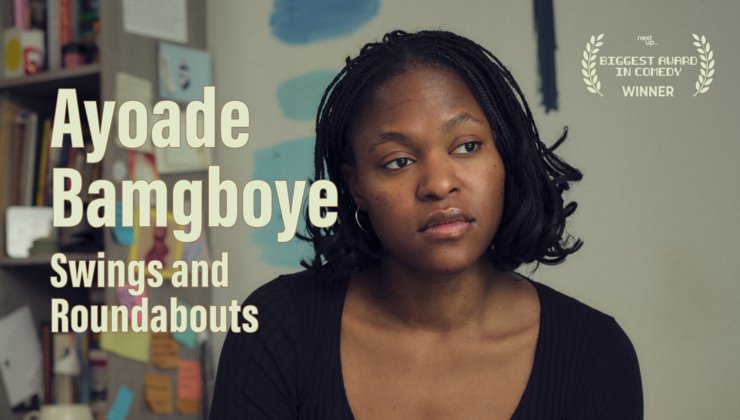
Ayoade Bamgboye: Swings and Roundabouts (2025)
The version of Swings and Roundabouts on NextUp was filmed at the 2025 Edinburgh Fringe Festival, just hours after it was announced that this show had won the Best Newcomer Award. That was an exciting moment to catch it on film, which I can attest, as the NextUp video also features Yours Truly sitting in the audience, feeling very pleased with the decision I’d made several months earlier to buy a ticket for this up-and-coming comedian. Since then she’s come up very fast, winning the Newcomer Award and a prominent spot on SNL UK.
If we’re putting reductive labels on stand-up shows, Swings and Roundabouts can be called a Feminist Show. It can also be labelled as the famous Dead Dad Show. It’s an Immigrant Experience Show. It’s a Mental Health Show. It’s a Collaborative Audience Participation Show, but crowd members only have to answer questions from their seats, no one gets up on stage (Yours Truly fortunately avoided this, though you can see me awkwardly leaning away to try to stay out of shot while Bamgboye questioned the person beside me about c-sections versus vaginal births).
Bamgboye has a very compelling stage presence, especially for a debut hour. She draws you in with her inquisitive attitude and conversational tone. She’s structured the hour deceptively well, so it can feel like she’s meandering, but she’s really dropping just enough information to keep you wanting to follow her lines of thought.
This show is, among other things, about struggling with different aspects of identity that get emphasized in different places. Being a daughter in her family, a girl in Nigeria, a black person in England. It’s also about the mismatch between how she perceives herself and how others perceive her, at least partly due to those identities. And it’s about trying to understand societies when she feels like an outsider everywhere.
It is also about grief and related depression, and goes to difficult places at times, but Bamgboye always makes it funny, and her bright disposition keeps the audience in safe hands.
Fern Brady: Power and Chaos (2021)
A big theme of Power and Chaos is how Fern Brady dealt with the fame she’d experienced by 2021, which is interesting, as this was her last special before she appeared on Taskmaster, after which she had a further major increase in fame. It’s also her first show after being diagnosed with autism; it discusses unsentimentally, and entertainingly, how badly fame and autism can interact.
Brady discusses nearly everything unsentimentally in this show, including some heavy topics like spending time in a psychiatric hospital, dealing with sexual harassment, having an abortion, being pressured to come out as bisexual to her conservative family, and deciding whether to have a baby.
Brady plays with a lot of stereotypes in Power and Chaos: stereotypes about girls and women, about Scottish people, about disabled and neurodivergent people, about queer people. Because all these identities meet in one comedian, she can laugh at the way the stereotypes contradict each other. No one could live up to every expectation at once, even if they wanted to. And Fern Brady does not want to, but she’s well placed to comment on them all.
This show contains some very funny stories about unusual experiences, and all the way through, it feels frank and honest. Brady complains in the show about reviewers calling her “forthright”, but it’s hard to avoid that word when describing her attitude, and her comedy is better for it. She doesn’t sugar coat things, she doesn’t apologize for her anger of frustration.
Desiree Burch: Unf*ckble (2021)
Unf*ckable is a big, powerful show that tackles many ideas at once, some seemingly contradictory, and Burch audaciously demands to have all different aspects of herself recognized. One major contradiction is in the title itself: a show about being allegedly “unfuckable”, when Burch acknowledges that many people will have come to see it because she’s open about her past as a sex worker, and they want the salacious details.
Burch delivers some of those details in a way that’s confronting and unromanticized. The focus is always on her own inner perspective, resolutely making herself a subject in a story where the viewer so often makes her an object.
This is a show about being a woman in a world dominated by men, a black woman in a world dominated by white people, and a fat black woman in a world dominated by beauty standards that exclude her. Burch repeatedly hits on the intersection of all these things, in a way that feels raw and personal and never academic. This is the type of shouty comedy that will remind you that shouty comedy can be intelligent. This comedy special is very intelligent, but Burch is so passionate and loud that it can be easy to overlook the depth of her analysis.
Unf*ckable will draw viewers in with its explicit stories about sex and kink – which are funny, and find novel ground in this common stand-up topic – but it will keep you there for the explanation and condemnation of what objectification does to a person – and Burch manages the Herculean task of making that also funny, even when it’s painful. She rants righteously about the stereotypes she’s supposed to embody, and contrasts those against her real self.
Finally, if you find the recent comedy world news triggering, Unf*ckable contains a Metoo story that is harrowing, but ends up offering some light in the dark.
Susan Calman – Ladylike (2015)
This was fun to watch after the Fern Brady special, because any collection of great feminist comedy will feature multiple queer women from Scotland (spoiler for later parts of this collection: there are three more of them coming up). Susan Calman is also, interestingly, one of two people on this list who was a lawyer before she quit to become a comedian. Apparently the gruelling law hours can sharpen comedy into people’s brains.
Ladylike plays on the words in the title in a few ways: it’s a show about Susan Calman’s relationship to the pressure to the “ladylike”, about how much she likes other ladies despite facing homophobia for it, and how depression makes it a struggle to like the lady who is herself.
Calman is a very likeable performer, bright and affable and enthusiastic about convincing the audience of the merits in things she loves – these things include her wife, her cats, Helen Mirren, and the sewers below Paris. She is proud of the life that she’s had to fight to build for herself, resisting the expectations to be things she did not want, waiting until gay marriage was legal to marry her partner. And now she wants to share it with everyone.
She talks about stuff that contributes to her depression, including misogynistic, homophobic, and fatphobic comments that come with being a lesbian who appears on TV sometimes (not to mention a Scottish voice on the radio, which manages to also offend some people). But this show is far less about those negative things, and far more about all the things she loves, and how she uses them to combat the negativity.
Bridget Christie: Stand Up For Her (2016)
Stand Up For Her is a 2016 recording of A Bic For Her, the show that won Bridget Christie the Edinburgh Comedy Award (then called one of its many other names) in 2013. It brings in elements of Christie’s older shows, when she was more clownlike and played absurd characters, but this time, she’s being herself. That leaves this show as an unusual blend of the silly and the serious, sincere monologues about sexism combined with throwing herself all over the stage to chase a pen.
I know a show is full of great lines when, upon reviewing it, I have to constantly stop myself from giving away punchlines by quoting it. Suffice to say this hour is worth watching for every surprise, every time Christie expertly turns common ideas on their head. Many lines are so good that it can be easy to forget this show also has great physical comedy.
This show has many ideas from old-school feminism, and it’s a sign of how much unfair stigma gets attached to these things that I feel the need to add “I don’t mean that as a bad thing.” She talks about women getting overly sexualized in the media, women getting stereotyped in advertisements, women getting condescended to by corporations, women’s sections of bookstores being maligned, women’s looks being valued at the expense of their accomplishments, the ridiculousness of beauty standards that involve cosmetic surgery.
The depth of Christie’s sarcasm is truly impressive. The amount of genuine anger, and the many layers of silliness on top of it, come out in relentlessly sardonic waves.
It’s fun to watch Stand Up For Her while this week’s news dominates public discussion, as this show contains a brilliant takedown of a certain comedian-turned-Hollywood-star-turned-religious-philosopher who can now legally be called a rapist. He couldn’t be legally called that in 2016, but Bridget Christie still took down his paper-thin claims of virtue with gusto. And the final line of Stand-Up For Her show is, without giving away any spoilers, extremely satisfying to watch on this week.
 Alex Finch