
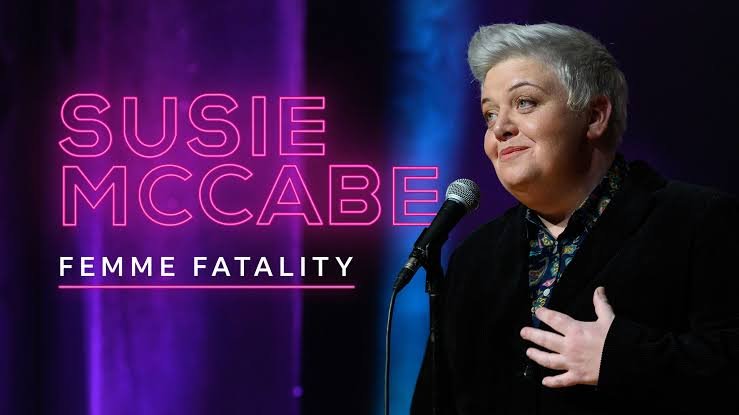
Susie McCabe: Femme Fatality (2023)
I said there were more shows by queer Scottish comedians on this list, and here’s a major one. Susie McCabe: Glaswegian working class butch lesbian leftist comedian. She opens Femme Fatality by declaring that Scotland legalized homosexuality the year she was born – a fairly horrifying fact, given that that was 1980, which is far too recent – because they saw her coming and needed to be ready.
This is a show about stereotypes, and about fitting in. McCabe shares her experiences in various gendered environments, a major one being a male-dominated building site where she used to work. She chronicles the casual sexism and homophobia built into language and jokes. The way she normalized it, even went along with it because that was how to be accepted by the community – this will be a familiar story any woman who’s been used to a male-dominated environment, and it’s a story that’s not told often enough. The sexist jokes that people use to bond over, that people don’t mean in a bad way, that can be mixed in with all kinds of genuinely positive stuff.
Femme Fatality is full of classic stories about general mismatches, different people who have different ideas about what it means to fit in. These differences often fall along generational lines, on how close a person’s birth was to Scotland’s legalization of homosexuality. There are sweet stories of people who change over time, who find ways to keep some parts of outdated cultures while shedding others.
McCabe delivers all these stories conversationally, with no judgement toward any of the people in them. She’s interested in understanding where everyone comes from. She analyzes her own place in those stories, reflects on the way her perspective has changed, and how it’s shaped the person she became, for good and for bad.
Njambi McGrath: Benevolence (2024)
Njambi McGrath grew up in Kenya, and is now a comedian in the UK who has written this show about global dehumanization of African people. Within that, she hits many different topics: colonization, resource exploitation, stealing their stuff and putting it in Western museums, predatory debt creation by the IMF, condescending stereotypes of Africans as backwards/underdeveloped, the global for-profit industry of “charity for Africa” that does little good and sometimes active harm toward Africans while Western people get rich off it, white people on their gap years who go to Africa to “volunteer” and make things worse, religious missionaries who raise money for Africans and spend it on giving them Bibles instead of food.
The show’s title, Benevolence, refers to all those people and industries that claim to be acting in the best interest of Africans, but really act at Africans’ expense. McGrath complains that everyone wants to feel like they’re helping Africans, but not by giving them things like wifi or visas, that would acknowledge Africans as part of the actual world.
Benevolence touches on some issues that are sex-specific, like a routine about the similarities between the Chinese one-child policy and the Western world’s right-wing anti-abortion policies, that both tell women what to do with their bodies. These parts of the show are explicitly feminist, but I consider the entire show to have a feminist message, because it is feminist to argue for an exploited group’s economic and social liberation – in this case that group is all African people, about half of whom are women and girls.
Like with many shows on this list, after explaining the topic, I feel the need to add: but honestly, it’s really funny! And it is. McGrath has a great stage presence, a great instinct for when to push a point hard and when to draw back, a great ability to find the absurdity in ideas that have been normalized. There are a lot of laughs in this show, even though there’s also a lot of confrontation of difficult reality.
Aditi Mittal: Mother of Invention (2019)
Aditi Mittal is a comedian from Mumbai, who started comedy when stand-up in India was relatively new, and stand-up in India performed by women was even newer. The Indian live comedy industry has become much bigger since then, but she has a singular perspective as a pioneer who created a career in a field that, at the time, hardly existed.
Mother of Invention dissects various aspects of why Mittal became a person who did that, and what obstacles faced her along the way. These include her mother, her father, gender-based pressures from her family and her wider culture, Indian religious blasphemy laws, and corporate faux-feminism that exploits women further. Much of the show’s ethos can be summarized in this brilliant quote from near the beginning: “Empowerment is like matter, it can neither be created nor destroyed, it just changes from one form to the other. And they throw it out there and let the women fight over it.”
Mittal chronicles her upbringing, which is unusual in many ways, but is also a classic coming-of-age tale in which a daughter learns that her mother has more to offer than it once seemed. She structures this story around discussions of ways in which society conceptualizes “motherhood”. The way we apply motherhood to scared symbols and abstract ideas, but rarely revere the actual human mothers as much as the concept of motherhood.
A similar look is taken at how society considers women as a whole – with reverence when they are objects, but disrespect when they ask to be subjects. This is illustrated in some very funny stories about events that exploit the idea of feminism – the type of events that want to use one of India’s first female stand-up comedians, but don’t want the full human being who’s attached.
At the heart of this show are touching ideas about family and how to recognize genuine love, but along the way we get a whole lot funny stories about how absurd it is when you take rigid cultural traditions to extremes.
Eleanor Morton: Great Title, Glamorous Photo (2019)
In this show, Morton switches between two characters: one a version of herself with a few biographical details tweaked, and the other a glamorous female American comedian (these may not be the only characters who appear, you’ll have to watch the show to find out).
The latter character is very accurate, and will be recognizable to anyone who’s spent a lot of time in types of comedy clubs where it’s a popular style. There are real women who perform like that, and it would be so easy for Morton to write lazy jokes at their expense, born of internalized misogyny. But Morton has taken great care to not just make her character a cruel parody; she presents this other type of woman, as different from herself, but equally sympathetic and layered. It’s a tall order to do this while also making the jokes about this character funny, and Morton pulls it off.
The heart of this show is anger at the sexualization and objectification of women, particularly women in comedy; and the double standards about men, particularly men in comedy, who get away with significantly less focus on their physical appearances. This seems to be inspired by Morton’s brushes with the TV industry, and what is expected for a woman to be “TV ready”.
Morton expresses her feelings on this serious subject in a very silly way, with two over-the-top characters, one TV ready and one not, as they discover what they do and don’t have in common. The contrasts of one character against another, and of the silliness in the execution against the gravity of the issues addressed, make for some great comedy. Every time Morton shifts from one mode into another, playing with accents and costumes to indicate changes, it gets funnier.
Oh, and for anyone who’s counting, this is show #4 by a queer Scottish comedian, on my list of twenty. It’s a very strong demographic.
Sam Nicoresti: Cancel Anti-Wokeflake Snow Culture (2022)
This special pushes the boundaries not just of stand-up, but of creative ways to translate it from the live room to the screen. It swaps back and forth between Sam Nicoresti with the microphone on stage, and pre-filmed segments of Nicoresti’s alter-ego broadcasting from inside her own brain. We also see occasional filmed bits set in a frog-filled forest, and a dark void of transmisogyny. The actual show is at least as weird as that description makes it sound, and it’s excellent.
Nicoresti explains that this is by design: she’s taking us on a journey through some complicated ideas, and illustrating how they feel by adding many odd twists and turns. These ideas include figuring out her own gender, figuring out what to do about having a gender that doesn’t match the one she was once assigned, making sense of what Freudian nightmares might be going on in transphobes’ psychological systems to create their rhetoric, and examining the role of an essential human soul in gender identity discourse. All these ideas could be explored with just Nicoresti and a microphone, but we’re able to go a little deeper once she introduces frogs and voids and dream interpretation and podcast parodies.
The spoof podcast is a real work of art – full of bonus details that a live audience would struggle to catch, like the email inbox. Grifting manosphere podcasters have been mocked and parodied many times, so a comedian needs an extra sharp take on it to stand out. Nicoresti nails that.
This isn’t all gimmicks for the filmed special; the jokes when it’s just Nicoresti and the microphone are strong, and brilliantly delivered with a captivating stage presence. The material is mostly about societal transphobia and Nicoresti’s personal coming out journey, though there’s also a bit of introspection into the nature of gender identity itself. It’s a great time.