
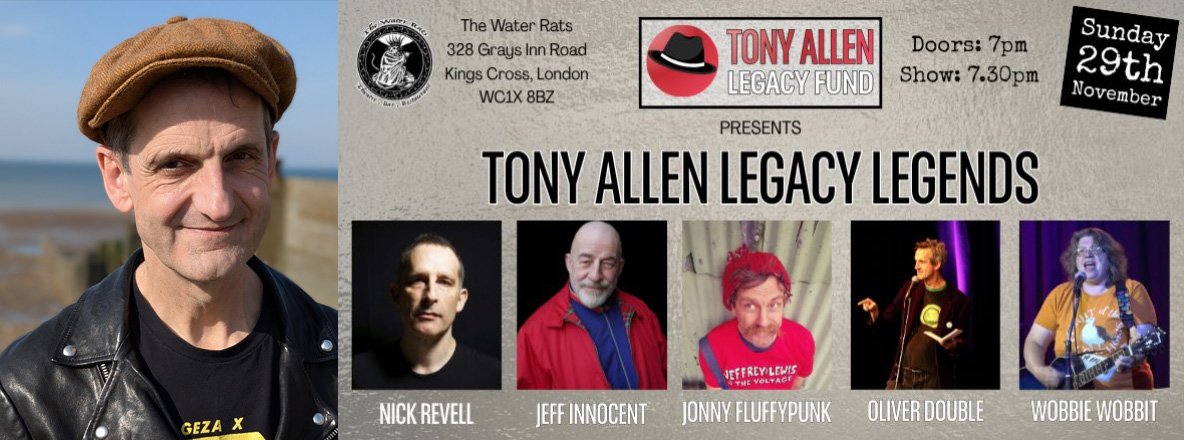
This coming Sunday, legendary London venue The Water Rats is playing host to a comedy night that will commemorate and celebrate Tony Allen, self-proclaimed ‘mixed ability shaman’ and the Godfather of Alternative Comedy, who died in December 2023.
Punchline writer Dave Baillie tracked down one of the acts performing that night – a legend in his own right; academic, author and stand-up Oliver Double – to talk about Tony, the gig, and an interesting theory on the development of stand-up as an art form that Dave’s been attributing to Oliver for years, without checking if he’d heard it right.
Remembering Tony Allen
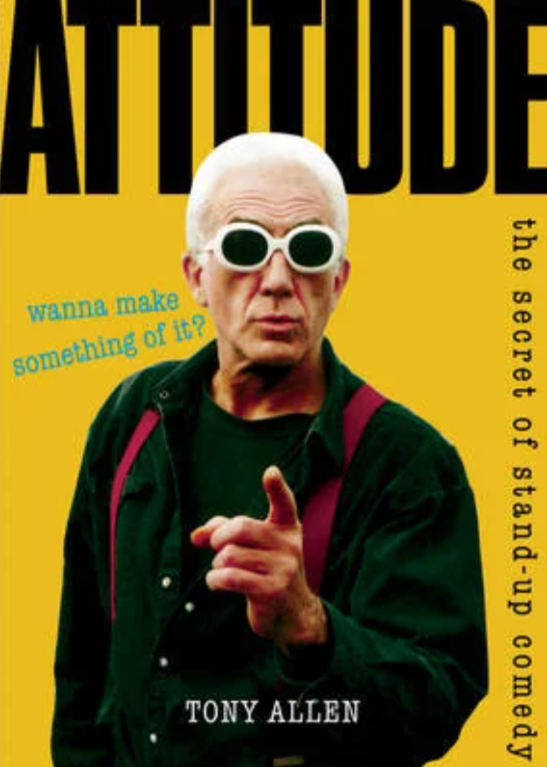
DB: I only saw Tony perform once, when he compèred the Alternative Cabaret 40th Anniversary gig at the Water Rats. I had read his book Attitude years before, and heard that he put on small gigs in Ladbroke Grove, but I always seemed to find out about them the week after they happened. That was the only chance I got to see him in a room, and it was absolutely fantastic.
Oliver Double: He was a really, really great comic, although fairly erratic. Those two things might be connected. Towards the end of his performing career, before he moved away from stand-up in the nineties, he could be a genius, or it could just crash and not work at all.
I remember he did a run of gigs in Sheffield as part of the Sheffield Festival in the early nineties. It wasn’t the first time I’d seen him, but it was probably the best. It was in a rather small room in a pub, quite close and intimate. There was an open door at the back, opening out into the void, and there was a storm. He was talking about chaos theory and things like that, and then the storm broke. You could hear the crash of lightning… Crash! Crash! crash! And then the microphone fell apart for no apparent reason. There were so many good things about that gig, but that was an amazing moment I’ll never forget.
He would talk about esoteric things in his stand-up. He’d talk about chaos theory, Heisenberg’s uncertainty principle, rainforest tribes and the futures market, and weave all these things together in an accessible way. I don’t think you’d hear any other comedian talking about that stuff. He brought this outsider’s vision to the stage.
DB: Could you talk a little about how important Tony Allen was to the beginnings of alternative comedy and stand-up in the UK?
Oliver Double: I’ve always said there were three starting points for alternative comedy, which we might extend to the comedy we have today.
One was The ComedyStore, which was fundamentally important because it brought together people with similar ideas and helped them find each other. It created the critical mass that allowed a movement to happen.
Then there was The Comic Strip, which was hugely important because it was how people around the country discovered this stuff. The Young Ones essentially came out of The Comic Strip, and both were important in making alternative comedy a national movement.
But the other leg of the three-legged stool was Alternative Cabaret. In many ways, it was the most important because it established the model for the sort of comedy gigs we have today.
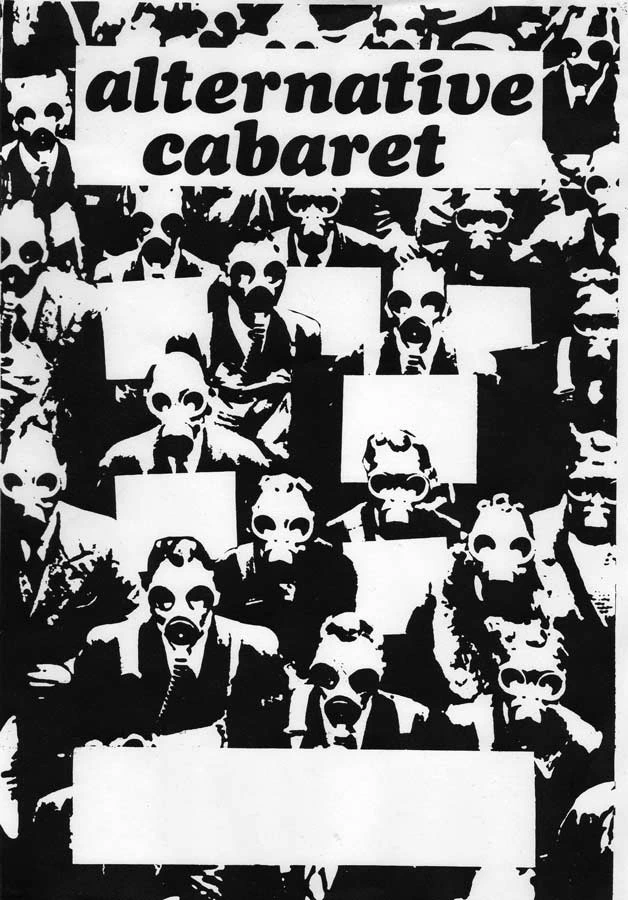
They were a group that ran regular gigs in a pub, I think every fortnight, but they also performed all around London: in theatres, student unions, pubs and even cinemas. They established the template for people to set up small comedy clubs. And Tony was really at the core of that. I’m sure he came up with the name Alternative Cabaret. It was in his flat that they met to plan everything.
He was known as the Godfather of alternative comedy, and I think that was because he was such an influential figure in those early days.
DB: Am I right in thinking that grew out of his career as an elite London squatter?
Oliver Double: Tony was a really important countercultural figure. Even before he got involved in comedy, he was part of the squatting movement in the seventies. He worked alongside people like Heathcote Williams, the poet, and they ran the Rough Suburban Estate Agency of Squatters, which was a sort of parodic estate agency offering advice to squatters.
He was also part of a group called Rough Theatre, which did really non-conformist, anarchic street theatre. They were involved in all sorts of different things.
Through his involvement in squatting, he was also friends with Joe Strummer, back when Joe was still Woody, after Woody Guthrie. Later, Tony supported the Clash. He did a gig supporting them in Portsmouth, I think, when the Falklands War was happening. He also supported Killing Joke once.
It’s funny, he had this anti-work ethic: he thought nobody should work. It’s unbelievable, really, because when you read through his diaries, you can see that he actually worked really hard. Just not at things that would be considered conventional work.
He did street theatre, wrote radio plays for the BBC, he was involved in workshops, and constantly had projects he was trying to develop. He wrote pieces for International Times. He also became a regular at Speakers Corner for a big chunk of his life, and wrote a great book about that.
He was writing about the idea of doing stand-up a long time before he first did it. There are ideas and material right there in his diaries.
DB: And Tony was there pretty much at the start of the Comedy Store, wasn’t he?
Oliver Double: When the Comedy Store opened, he would certainly have known about it, although I think he was away doing anti-nuclear action somewhere in Scotland when it first opened, so he missed the opening. He was around within weeks, though. When he turned up, Alexei Sayle, who had been the original compere, was feeling a bit despairing. There were people who’d done Oxbridge revue comedy, some rather sad old working men’s club comics, and a load of deluded people. Alexei wasn’t sure it was going to turn into anything.
But when Tony turned up and, even though they had lots of differences, they also had a lot of similarities. They were both only children, for example, with very dominant mothers and slightly problematic relationships with them. I’m not a psychologist, but it is interesting that they shared those biographical details.
By August, they were doing their first Alternative Cabaret gigs. The Comedy Store had opened in May, so this was only a few months later. They did two gigs on consecutive nights. The first was at the Water Rats [called The Pindar of Wakefield, at the time] and the next night was the first gig of their ten-month residency at The Elgin.
Tony told me when I first met him that The Elgin was the first actual alternative comedy club. The Comedy Store had been set up as a showcase for new talent. It wasn’t specifically set up as an alternative night, and it only really got rid of the other types of acts a year or eighteen months into its existence.
Alternative Cabaret at the Elgin was different. It was a place where lefties, squatters, anarchists and activists would go. The acts were more carefully curated: Andy de la Tour, Jim Barkley, Tony, Alexei and others. Alternative Cabaret, and Alternative Comedy, went from being the name of the group to the name of the movement.
DB: I was honoured to write Tony’s obituary for Judge Dredd Monthly after he died – as you know, he was an early contributor to the magazine. You mentioned, when we chatted for that, receiving some of his Dredd pieces for your Comedy Archive at the University of Kent?
Oliver Double: Yeah, he gave me a bunch of things, including rough test layouts and early editions of Judge Dredd where he’d done the Mega-City News pages, with fake news stories and adverts.
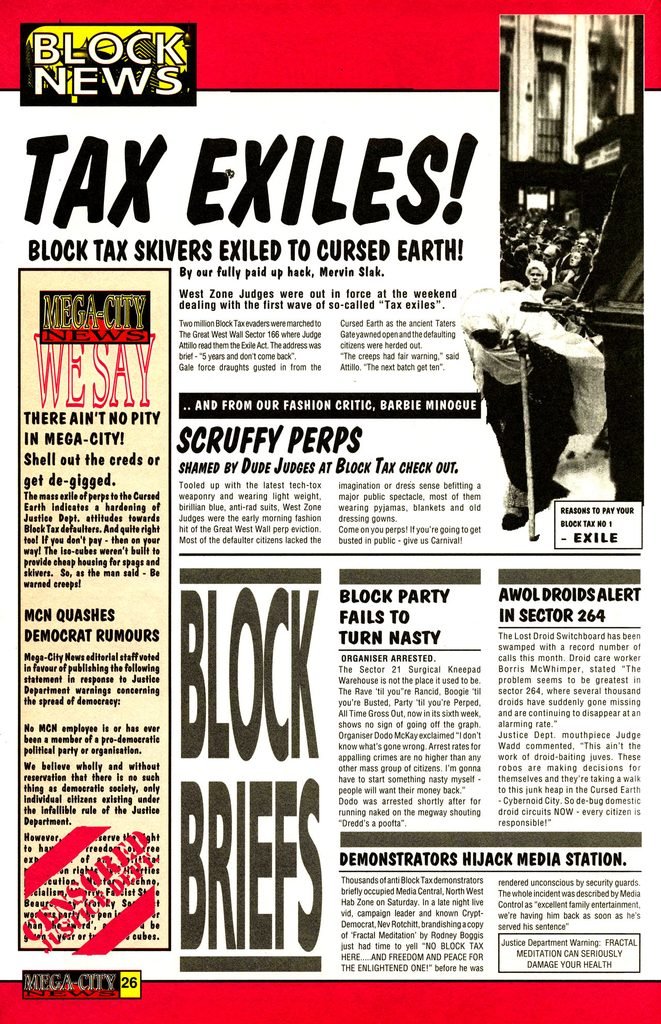
I knew about that material because I read Judge Dredd Megazine. I also knew he’d done some stories for Crisis, another 2000 AD spin-off. If you’re an academic, you’re a nerd by profession, and that’s what I do professionally: I nerd out. Part of having that personality is that if you’re interested in somebody, every time you happen across their work, your ears prick up.
I remember the first time I heard about Tony Allen. I had an anarchist friend who’d seen him perform at the university where I was studying. She told me about him, and for some reason it really stuck in my head. Then when I started researching the history of alternative comedy, his name obviously came up all the time. I bought a book as a student called Cabaret: The First Hundred Years by Lisa Appignanesi, and he was in there too.
I found him really inspiring. I saw him as often as possible and followed his work. I’d have read Crisis anyway, and I’d read the entire run of Judge Dredd at one point. So whenever Tony’s name came up, I was interested. Finding that material in his personal archive was fascinating.
Tony’s approach to comedy and teaching
DB: And Tony came to speak to your students numerous times over the years?
Oliver Double: Yes. And there are a few things that Tony talked about which I still bring into my teaching today. One was: “Everything that happens in this room is part of the performance.” If somebody walks in and interrupts, you have to respond to that.
Another was a question he’d ask when students were performing: “Who are they when they’re up there?” It’s a great way of putting it.
Another expression, which I think might have come partly through Den Levitt, because she used to teach with Tony, was “double-click on that”, meaning to zoom in and examine it.
Tony was very good at finding neat ways of expressing ideas about comedy. He said a couple of things to me in our last conversations, one was that the last sort of comic theory he’d come up with was “Think Funny”.
The idea was that being able to joke about something requires you to have some sort of comic distance from it. If you can think funny, you can see things for how they are more clearly, because you’re constantly looking for what doesn’t fit.
The example he gave me was when he saw all those people lined up at the living wake. He said, “I must die more often.”
I think that’s a great joke. It’s a really good example of thinking funny.
The Tony Allen Legacy Legends
DB: The Tony Allen Legacy Legends gig is this Sunday. Who put it together, and are the performers all former students, friends and people who worked with Tony?
Oliver Double: The person who’s really put it together is Den Levitt, who’s billed as Wobbie Wobbit. She’s a comic singer and a long-time friend. Den did a lot of work with Tony, including graphic design and putting posters together. She’s a really interesting person, very quirky, and has a very quirky act.
Another of the acts on the bill is Johnny Fluffy Punk, who was another one of Tony’s people.
Johnny is a really, really funny poet, and I think it was during a workshop or something. Tony said he was a poet, but also like a fluffy punk. So Johnny adopted it. Years later, Tony apparently said to Johnny, “Why have you got that stupid stage name?”
Johnny officiated at Tony’s funeral, and he got by far the biggest laugh I’ve ever heard at a funeral when he quoted something Tony had said to him. It was brilliant and fantastically appropriate for Tony. I loved his funeral. Obviously, I was very sad that Tony wasn’t there, but it was a fantastic celebration of his life, and Johnny was brilliant in that role.
DB: And the great Jeff Innocent is also part of the line-up, of course! I did Jeff’s comedy course a couple of times a few years ago, and one of the reasons I was so keen to do it was that Jeff had talked on a podcast (ComComPod, I think) about hoping to continue Tony’s teaching traditions.
Oliver Double: Yeah, Jeff did Tony’s course many years ago. Tony really liked Jeff, and he really championed him. He talked about Jeff a lot.
DB: And Nick Revell will be doing a Tony Allen tribute?
Oliver Double: Nick Revell was quite a big name on the circuit in the eighties. He had his own television pilot, The Nick Revel Show, and he also did a radio show on Radio 4 for a long time during the eighties with Andy Hamilton, called The Million Pound Radio Show. He was a really good comic, in the same sort of ilk as Jeremy Hardy, Mark Thomas and Linda Smith.
At Tony’s living wake, which was at a pub near where Tony lived, Nick was quite late in the bill. He spoke about Tony and how influential he’d been on him, and then started channelling Tony, doing bits of his act. People really liked it, especially those who knew Tony and his work.
I think that’s what he’s going to do at this gig. He’ll probably be a bit more prepared than last time, but he’ll essentially be channelling Tony’s material, which is quite an interesting thing to do.
DB: You mentioned Tony’s living wake. That was a celebration of his life while he was still with us, wasn’t it? I watched some of that on YouTube, it’s brilliant! [There’s a section of it online containing a brilliant argument between Alexei Sayle and Tony about limos! https://www.youtube.com/watch?v=MJe76VJQiVE&t=48s]
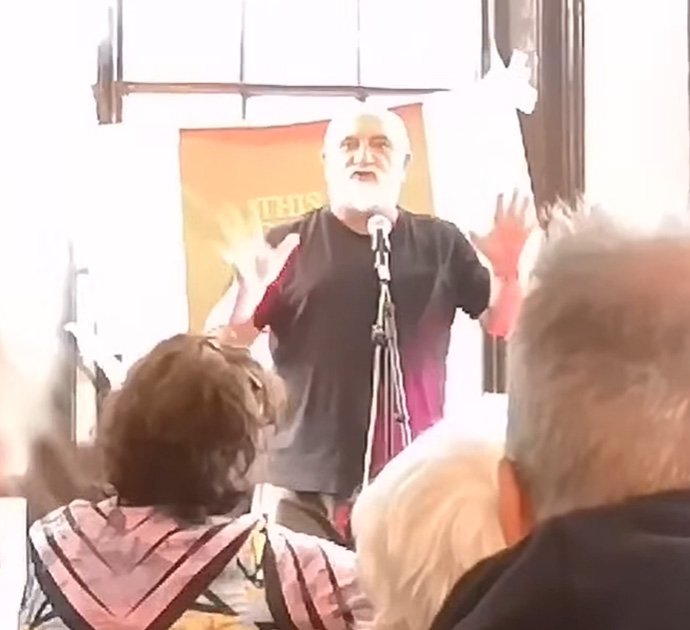
Oliver Double: It was a great event. There were lots of different people there, some great performers. A number of people were there who didn’t perform, including Keith Allen, who was just sitting in the audience with his dog. John Hegley did something, in fact, something he’d written especially about Tony. I got up and did a little bit, just telling a couple of stories about Tony coming in to teach my students.
DB: I think it’s mentioned in the YouTube stream that Tony didn’t stick around for the whole wake? Didn’t he heckle a little, too?
Oliver Double: It’s quite a heavy thing, isn’t it? You have a gig in your memory, but you’re still alive. It’s very on-brand for Tony to have a gig in his memory while he’s still around, and then heckle people.
But you’re also faced with the fact that you’re not going to be around much longer. All these people are saying nice things about you and performing material in your honour. I imagine that’s quite a lot to deal with emotionally.I think he watched it all later, though.
DB: And you’re performing this Sunday?
Oliver Double: I am! It’s interesting for me to be doing this gig because I don’t really do gigs apart from the compèring I do here at the university.
DB: That’s a regular gig, isn’t it? [The Funny Rabbit Comedy Club, at the Gulbenkian Arts Centre in Canterbury]
Oliver Double: We do about eight gigs a year: two four-month seasons of monthly shows.
But when they asked me to do this, and I thought, well, I’ve got to do it. I’ve assembled a bunch of different bits, and I’ll be doing some new songs, which hopefully will work.
Comedy, parenting and everyday performance
DB: There’s something I’ve been meaning to check with you actually. I’ve been repeating a theory of yours, at least I hope it is yours, that I read somewhere years and years ago. The only problem is that when I tried to track down where I’d read it, I couldn’t find it. I checked all your books, and the academic papers of yours that are online.
The way I remember it is that you proposed that a lot of the tools of stand-up comedy were developed while trying to entertain, distract or cheer up children – that a lot of stand-up techniques in fact evolved from parenting techniques. Do you remember writing that anywhere?
Oliver Double: I don’t think I’ve written that down. It’s possible I said it somewhere, perhaps on a podcast. It sounds like the sort of thing I would say. I certainly think a lot of the things you do as a comedian have analogies in everyday interaction, including parenting and conversation.
There’s an interesting example in the work of the great German playwright Bertolt Brecht. He wrote an iconic essay called “The Street Scene”, where he uses the analogy of people describing what happened in a car accident as a model for acting. He says that when witnesses describe what happened, they’re not looking for the psychological realism of a character, they’re only including the information that’s relevant.
In a footnote to that, he talks about another type of everyday acting. Imagine you’re talking to your neighbour and you have the same landlord. When you’re talking about him, you might imitate the landlord for comic effect. That really struck me when I first read it. It’s only a short piece of writing, but the way Brecht describes that type of conversation really sounds like the sort of thing a stand-up would do.
As humans, when we talk to each other, we naturally imitate people. When we’re describing something that happened, we momentarily imitate the person who did it, and then ourselves in the past, saying something back, and so on. It’s such a common stand-up technique. Tony would call that mimicry, I think. There are all sorts of things going on in those everyday interactions.
The Tony Allen Legacy Legends is happening at 7pm at the Water rats pub near Kings Cross, tickets can be found here:
 Sarah Stringer